|
|
This blog is part of unitarium.com site where you can find
unit converters, calculators and other information focused on units of measurement. See menu on the left.
Archive for the ‘Articles’ Category
Friday, October 23rd, 2015
Hurricane Patricia the most intense tropical cyclone ever observed in the Western Hemisphere is comming.
With measured winds speed of 200 MPH (322 km/h)
Hurricane Patricia became the strongest tropical cyclone ever recorded.
The minimum barometric pressure is
880 hPa (25.99 inHg, 660 mmHg),
and the hurricane is moving north-northwest,
speed – 10mph (9.7 knots, 16 km/h)
Storms with an intensity of 922 hPa (27.23 inHg) or less for only Eastern Pacific Ocean are listed below.
Source: East Pacific Hurricane Best Track File 1851–2014
| Cyclone |
Year |
Max. Speed |
Min. Pressure |
| Ava |
1973 |
260 km/h (160 mph) |
915 hPa (27.02 inHg) |
| Gilma |
1994 |
260 km/h (160 mph) |
920 hPa (27.17 inHg) |
| Guillermo |
1997 |
260 km/h (160 mph) |
919 hPa (27.14 inHg) |
| Linda |
1997 |
295 km/h (185 mph) |
902 hPa (26.64 inHg) |
| Elida |
2002 |
260 km/h (160 mph) |
921 hPa (27.20 inHg) |
| Hernan |
2002 |
260 km/h (160 mph) |
921 hPa (27.20 inHg) |
| Kenna |
2002 |
270 km/h (165 mph) |
913 hPa (26.96 inHg) |
| Ioke |
2006 |
260 km/h (160 mph) |
915 hPa (27.02 inHg) |
| Rick |
2009 |
285 km/h (180 mph) |
906 hPa (26.75 inHg) |
| Celia |
2010 |
260 km/h (160 mph) |
921 hPa (27.20 inHg) |
| Marie |
2014 |
260 km/h (160 mph) |
918 hPa (27.11 inHg) |
| Odile |
2014 |
220 km/h (140 mph) |
918 hPa (27.11 inHg) |
| Patricia |
2015 |
325 km/h (200 mph) |
880 hPa (25.99 inHg) |
Tags: hurricane, speed, storm
Posted in Articles | Comments Off on Hurricane Patricia Speed
Monday, June 17th, 2013
The next full moon falls on June 23, 2013 at 11:32 UTC. (US time zones: 4:32 am PDT, 5:32 a.m. MDT, 6:32 a.m. CDT, 7:32 a.m. for other time zones you can click the link to convert 11:32 UTC to your local time and date). This full moon will be called supermoon or super full moon or perigee full moon because of the closest approach of the full moon to the Earth for all of 2013. Supermoon could be up to 30% brighter and 14% larger then at its apogee furthest point.
See also: Moon Phase Tonight – current (or at any time) Moon’s phase and position, parameters, such as illumination, elongation, distance to the Earth, …
Table below lists supermoon dates between 2010 and 2016. As you can see on May 6, 2012 super full moon was ‘extremely super’. There was only 2 minutes difference between perigee and full moon.
| Year |
Super Full Moon |
Perigee |
Difference |
| Date UTC |
Dist. [km] |
Date UTC |
Dist. [km] |
Time |
Dist. [km] |
| 2010 |
Jan 30 6:19 |
356607.267 |
Jan 30 9:04 |
356593.813 |
2h 45m |
13.454 |
| 2011 |
Mar 19 18:11 |
356579.792 |
Mar 19 19:10 |
356578.229 |
0h 59m |
1.563 |
| 2012 |
May 6 3:36 |
356954.016 |
May 6 3:34 |
356954.015 |
0h 2m |
0.01 |
| 2013 |
Jun 23 11:32 |
356991.415 |
Jun 23 11:11 |
356991.226 |
0h 21m |
0.189 |
| 2014 |
Aug 10 18:11 |
356898.198 |
Aug 10 17:44 |
356897.888 |
0h 27m |
0.310 |
| 2015 |
Sep 28 2:52 |
356878.329 |
Sep 28 1:47 |
356876.424 |
1h 5m |
1.905 |
| 2016 |
Nov 14 13:54 |
356522.757 |
Nov 14 11:24 |
356511.782 |
2h 30m |
10.975 |
Tags: moon, supermoon
Posted in Articles | Comments Off on Supermoon Dates
Friday, May 24th, 2013
A penumbral lunar eclipse will take place on May 25, 2013.
Where the Moon eclipse will be visible?
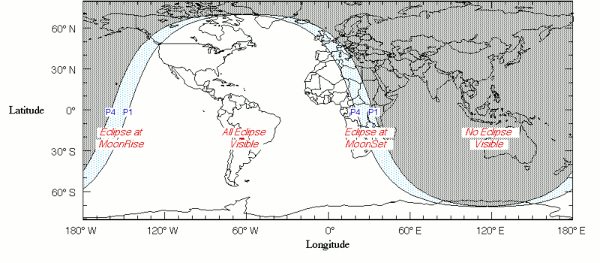
Figure below shows the Earth’s area where the Moon eclipse will be visible (source: eclipse.gsfc.nasa.gov)
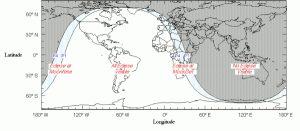
Click the image to enlarge. The eclipse will be visible in the white area, so as you can see, the eclipse will be visible from the Americas and western Africa.
What time will 25 May, 2013 Moon eclipse will take place?
Note: you can click on the links to see the UTC hours in your local time.
See also: Moon Phase Tonight Current or simulated Moon phase, position and Moon parameters such as Moon-Earth distance, illumination, declination etc.
Tags: eclipse, moon
Posted in Articles | Comments Off on Moon Eclipse 25 May 2013
Wednesday, July 4th, 2012
In Wimbledon’s quarterfinals:
Agnieszka Radwanska (POL) defeated Maria Kirilenko (RUS) 7 – 5, 4 – 6, 7 – 5
Serena Williams (USA) defeated Petra Kvitova (CZE) 6-3, 7-5
Angelique Kerber (GER) defeated Sabine Lisicki (GER) 6-3 6-7(7) 7-5
Victoria Azarenka (BLR) Tamira Paszek (AUT) 6-3 7-6(4)
World No 3. Agnieszka Radwanska will face Angelique Kerber (8) in the ladies’ semifinals.
World No 6. Serena Williams will face Victoria Azarenka (2) in the Wimbledon’s semifinal.
Ladies’ semifinals are scheduled to be played Thursday, July 5, 2012 at 12:00 UK time (11:00 UTC)
See also: Current Time At Wimbledon
Tags: sport, tennis, wimbledon
Posted in Articles | Comments Off on Wimbledon 2012 Ladies’ Semifinals
Thursday, June 28th, 2012
Today (28 July 2012) Italy wins over Germany 2:1 in semi-finals of UEFA European Football Championship EURO 2012. So, Italy will face Spain in the final on Sunday (July 1) in Kiev, Ukraine.
See also: EURO 2012 Time Now
Tags: euro 2012, football, sport
Posted in Articles | Comments Off on EURO 2012 – Italy vs Germany 2:1
Thursday, June 28th, 2012
On 28 June 2012, Lukas Rosol (27 years old) defeated Rafael Nadal (world number 2 ) at Wimbledon in the second round in five sets (6:7 (9-11), 6:4, 6:4, 2:6, 6:4), to achieve one of the biggest upsets in the tournament’s history. Tim Henman (retired English tennis player) cited his performance as a “freak match”, as it was only his 19th match win ever.
See also: Wimbledon – Current Time
Tags: sport, tennis, wimbledon
Posted in Articles | Comments Off on Lukas Rosol – Wimbledon
Sunday, September 25th, 2011
Patrick Makau from Kenya brakes men’s marathon world record on Sunday, 25 september 2011 and wins Berlin marathon. He ran 42 km and 195 meters (26.2188 miles) in 2 hours 3 minutes 38 seconds. The previous record was set by Haile Gebrselassie (Ethiopia) in 2008 on the same Berlin course.
Patrick Makau average speed during his winning marathon race in Berlin was: 42.195m/2h3m38s = 20.48km/h or 12.72 miles/hour (as you can compute in our speed calculator)
Tags: marathon, sport
Posted in Articles | Comments Off on Patrick Makau Record
Friday, September 23rd, 2011
According to the Albert Einstein theory, speed of light is the Universe’s ultimate speed limit, but an experiment that have been carrying by Dr Ereditato and his team for last three years suggest neutrinos can travel faster then light.
This puzzling result from Cern has to be investigated for possible errors. As Dr Ereditato says:
“We are not claiming things, we want just to be helped by the community in understanding our crazy result –
because it is crazy”
More about experiment (OPERA detector, measurement methods, data selection, conclusions) you can read on
“Measurement of the neutrino velocity with the OPERA detector in the CNGS beam”
http://arxiv.org/ftp/arxiv/papers/1109/1109.4897.pdf
The OPERA neutrino experiment at the underground Gran Sasso Laboratory has measured the
velocity of neutrinos from the CERN CNGS beam over a baseline of about 730 km with much higher
accuracy than previous studies conducted with accelerator neutrinos. The measurement is based on highstatistics
data taken by OPERA in the years 2009, 2010 and 2011. Dedicated upgrades of the CNGS
timing system and of the OPERA detector, as well as a high precision geodesy campaign for the
measurement of the neutrino baseline, allowed reaching comparable systematic and statistical accuracies.
An early arrival time of CNGS muon neutrinos with respect to the one computed assuming the speed of
light in vacuum of (60.7 ± 6.9 (stat.) ± 7.4 (sys.)) ns was measured. This anomaly corresponds to a relative
difference of the muon neutrino velocity with respect to the speed of light (v-c)/c = (2.48 ± 0.28 (stat.) ±
0.30 (sys.)) ×10-5.
Tags: neutrino, speed, speed of light
Posted in Articles | 3 Comments »
Friday, September 2nd, 2011
Another big sport competition (except World Championships in Athletics mentioned in the previous post – Current time in Korea) currently being held is US Open – hardcourt tennis tournament which is a part of, so called, Grand Slam.
Since 1978 has been played at Flushing Meadows-Corona Park in Queens, New York City, USA.
For those who want to check the current local time in New York City, here is the link:
NYC current time
US Open 2011 is scheduled to be played from August 29 to September 11, 2011.
First matches start usually at 10:00 AM or 11:00 AM EDT (Eastern Daylight Time – NYC Time)
More Info about NYC Time:
UTC offset: UTC-4:00
Daylight Saving Time: Yes
Timezone: EDT Eastern Daylight Time (North America)
Current Time Difference between NYC and:
Los Angeles: -3 hours
London: +5 hours
Moscow: +8 hours
Tokyo: +13 hours
Sydney: +14 hours
Tags: sport, world time
Posted in Articles | Comments Off on US Open, current time
Tuesday, June 22nd, 2010
Look at the below visualisation of the situation in FIFA 2010 World Cup’s Group C before last phase of the group stage. Each square of the drawing represents different result of the both last matches in group C (England vs. Slovenia and USA vs. Algeria) and colors on the drawing tell us who will be qualified to the next round.
Below drawing of visual analysis comes from : FIFA 2010 Group C Analysis
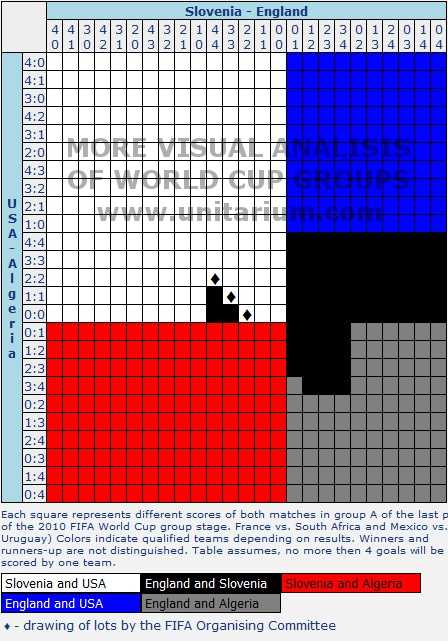
Black, blue and gray squares indicate that England will be qualified. As you can see, if they win against Slovenia a least 1:0, they will be qualified to the next round. There are also some cases in which England will advance, if they draw the match (black squares in the middle of the drawing). There are also three pairs of interesting results (USA – Algeria 2:2,1:1,0:0 and England – Slovenia 1:1,2:2,3:3) marked by the black diamonds. In this case both teams have same number of points (3), same number of goals (3,4 or 5 depending on the result) and same number of goals scored in match between USA and England. Due to the terms of FIFA World Cup, drawing of lots will be needed to find the winner.
Tags: mundial, sport
Posted in Articles | Comments Off on England’s chances to go out the group
|